Showing posts with label White Stripes. Show all posts

Wednesday, June 12, 2013

Serious Contenders: The White Stripes, "Fell In Love With a Girl" & "We're Going to Be Friends"


Looking at the Wikipedia article "2002 in Music" brings back a lot of memories. Not always pleasant ones. Looking at the tracks listed under the top hits of the year, you see rock represented by Nickelback, Sum-41, Blink-182, Matchbox-20, Staind, Goo Goo Dolls, Coldplay, Creed, POD, Puddle of Mudd, and Foo Fighters... and while there are two or three bands listed there that I like or don't mind, a pattern sort of emerges.

None of their songs are about girls.

Oh, some of the songs are about relationships: "How You Remind Me," sorta, "Disease" by Matchbox-20, in their Matchbox-20 kinda way... but the one quirk of the post-grunge era was that it was not cool to be in love. It just wasn't. You had to be above it. I feel like the last great rock single about being in love before this was "Sweet Child O' Mine," or maybe "Buddy Holly." Every song about a boy-girl relationship from the 90s onward seemingly had to be about what a headache it was, or how miserable of a person the guy was: alternative rockers and mainstream ones alike had to find ways to circle around the idea without ever really allowing it to speak for itself. And I love the 90s. And there are plenty of holes in this theory, but they're outliers. And really, so were the White Stripes when they arrived on the scene. Even the bands they were bundled with in the so-called neo-Garage movement, weren't really writing about the same things. Jack White wanted to talk about girls. And not about scoring, or fumbling your way through an awkward first date like a pop-punker. He just wanted to sing about the real feeling of being in love with someone. And that's why it was so shocking when there appeared a song literally called "Fell In Love With A Girl." It felt practically like a novelty, but it was for real.

And it's far from an oddity in the Stripes' catalog. That album, White Blood Cells, is steeped in the language of young romance, sincere heartbreak like "Dead Leaves and the Dirty Ground," wistful recollections of youth like "We're Going To Be Friends." Somehow it becomes a daring statement just to peel back the layers of detachment and irony and reveal, "This is what we all want to say, isn't it?" And for my generation, it was. We had a thing to call our own. I was in Grade 10 when I heard this album, and it felt like I was living out this album a half dozen times a week.

That straightforwardness, in their lyrics, moods, construction, was what made the Stripes so attention-grabbing, a cultural force instead of a novelty. Love was suddenly not just the domain of starry-eyed popstars and R&B seduction artists. It was once again a going concern for grimy white teenage boys. The same way "Smells Like Teen Spirit" taught Gen X that it was time to stop being shallow all the time, these tunes taught my generation that it was okay to give in sometimes. It was a cultural watershed moment.

Thursday, October 11, 2012

The White Stripes: Under Great White Northern Lights

On this live album, Jack White makes an addition to "The Union Forever," his song constructed entirely out of quotes from Citizen Kane, incorporating perhaps the best single line from the film: "It's no trick to make a lot of money if all you want is to make a lot of money." This line rings especially true to me given what I was saying about Jack's solo debut earlier this week, how he managed to make a record people would want to hear without designing it as a record meant to be purely commercial. This guy has clearly always had his mind on more than merely taking from his audience's wallets. If he was just there to collect ticket fees, he probably would play his songs more faithfully to their studio recordings. Here is a live recording that does not merely contain a few rough edges. This live recording is constructed deliberately out of rough edges.

Live, the White Stripes played recklessly, like Jack's guitar was literally on fire and he needed to stamp it out with his fingers. That poor six-string is going to need trauma counseling after the way Jack treats it. In he moment, with the energy of a live presence, Jack finds new places in his songs to make them all raggedy and unconventional. Not only does his guitar wail out in pain, Jack himself screams like a maniac, possessed by the music rather than performing it. This is a double-faced album: it's unpolished, but it goes out of its way to revel in its lack of polish, makes a spectacle out of it.

While some songs are played with breakneck ferocity, others are transformed in other ways, like the abbreviated, altered, organ-based "Ball and Biscuit," arguably preferable to the original studio version. "Blue Orchid" is allowed to come alive in a way it didn't on Get Behind Me Satan, and they really bring the audience into the sinews of "I'm Slowly Turning Into You." Being that this was during the tour to promote Icky Thump, tracks from that album are the most faithful; the blemished twang of "300 MPH Torrential Outpour Blues" is even better live with hardly a moment changed, and "Prickly Thorn, But Sweetly Worn" is gorgeous. Speaking of gorgeous, there's "We're Going To Be Friends" and the always-showstopping cover of "Jolene." The harsher moments make the smoother ones that much better: the slowed-down version of "Fell In Love With a Girl," sounding like Joss Stone's cover, is another highlight. Ultimately, this winds up as a full-bodied performance that explores all the various extremes the band inhabited.

One of my favourite live moments on any album was on Nirvana's Live at Reading set, when they played "Smells Like Teen Spirit" with their disdain for the hit well displayed, intro-ing it with Boston's "More Than A Feeling" and deliberately fumbling through it. Jack tests "Seven Nation Army," arguably his greatest creation (not necessarily his greatest song, but the work that will always loom largest) by taking it to its brink, turning it into a monster and then slaying it. If it were recorded that way in the first place, Elephant would not have been the blockbuster record it was, but to an eager crowd, it's irresistible. You buy a studio album because you like the songs, but you buy a live album because you like the artist.

Buy this album now: iTunes Canada // iTunes USA // Amazon.ca // Amazon.com


Tuesday, March 1, 2011

Cover: The White Stripes, "Jolene"


Of all the male artists out there, there's a small minority who would see the value of singing "I'm begging of you, please don't take my man" simply because the lyrics as originally written say so (see also Me First & The Gimme Gimmes.) Jack knows the power of a good lyric, and belts it out with more conviction than anyone has a right to expect, and probably more passion than most of his own compositions. The White Stripes turned this Dolly Parton classic into a stomping blues-rocker that wails for mercy with earth-shattering guitars and a sinister shimmer in between. The Stripes are in fact excellent in their choices of covers as they always bring something to the table, whether it's the weary release of "I Just Don't Know What To Do With Myself" or the mariachi duel of "Conquest."

See also this live version where Jack muses that "right place, wrong time," is the story of his life, and of course, the Gimme Gimmes offering their riotous punk take on it.

Wednesday, February 9, 2011

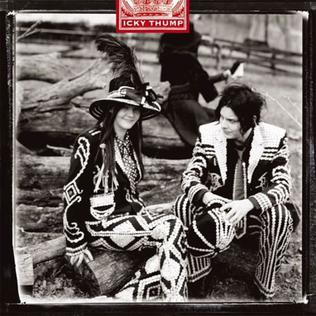
White Stripes: Icky Thump

I'm desperately fighting the urge to use my write-up/review/rambling thingy on The White Stripes' (apparent) final album to sum up my thoughts on their career as a group, but I can't really bring myself to do that. Mainly, of course, that's because that's not what I do here. Here, we talk about music more than musicians, and while there's always plenty of overlap, you can get the verdict on Jack and Meg's place in the history books plenty of other places. Me, I just like clicking "play."

There's such an air of bullshit surrounding the critical discourse of the band: from their brother/sister persona, Jack's retro tastes and their stripped-down sound, every review I read barely seems capable of approaching the music on the level of "something you listen to." And I get it, the band is fertile ground for meta-commentary, but if you're thinking too hard about it, you're not really doing your job (unless you're actually my ole Pop Music Professor, Josh Pilzer) and you're kinda missing out.

In re-listening to Icky Thump, I felt a mixture of sadness and contentment. Sadly, the band that recorded this CD had called it quits. Happily, this was the one to go out on. It's an unlikely choice for "consensus best Stripes album," but I think it's the one we can mostly agree on. White Blood Cells has (as do its predecessors) the potential of being an overrated indie darling, Elephant could be considered a problematic follow-up, and Get Behind Me Satan wears its oddness proudly. Any of those albums might be better, but Icky Thump? Icky Thump, I think, is the record everyone was waiting for the band to record. On it, Jack breaks his own rules (what with all the keyboards and organs and bagpipes and trumpets mingling with the guitars) writes several crash-and-bang rockers, a strong ballad or two, and just generally seems to be having a ball. Meg's there too, I think. Yet despite this obviously embellished sound, it never seems to violate Stripes "canon," and the songs foreground all the appropriate elements to feel familiar but fresh.

The album starts with probably their most potent opening salvo ever: four great tracks, all with their own unique qualities. The title track (a White Stripes first!) is that rare outwardly-political statement from a man who felt more at home stumping for Charles Foster Kane than any current candidate. It thumps ominously into being, militaristically while Jack yowls his frantic lyrics, which tie together in that cool postmodern Becklike way all the kids are imitating these days. Depending on your sympathies, you may not care for "White Americans, what? nothing better to do / Why don't ya kick yourselves out, you're an immigrant too!" but who can argue with "Who's using who / What should we do? / Well you can't be a pimp and a prostitute too!" which kind of adds to my earlier point that Jack is just a little bit of an MC, (like many great rockers though few would want to admit it.) The song manages to simulate boiling fury with an unholy keyboard solo that sounds like an angry mob clawing at the walls. It seems to be button mashing, but it illustrates the point quite well. Merging with that powerhouse riff is Meg, who is spot-on throughout the album.

If the thunder and lightning of the title track seems to spell doom, the next song is misleadingly welcoming in its sound. With one of the most radio-friendly hooks Jack White ever laid out and the most conventional structure (this album seems to be more built around verse-chorus-solo structure than others.) The song in question is the Earth-shatteringly wicked "You Don't Know What Love Is (You Just Do As You're Told)" which follows its easy, exhilarating riff with more accusatory lyrics: "n some respects I suspect you've got a respectable side / When pushed and pulled and pressured, you seldom run and hide / But it's for someone else's benefit, not what yoy want to do..." and though the most direct (and undeniably correct) interpretation of this song is that it's a call for people (probably women) to take control of their romantic lives, it also hits on notions of identity and self-determination that underline this album. Here, we get some real sonic power. Jack White had been "cheating" his "stripped-down" sound for years, overdubbing here and there, notably on the previous albums where marimbas were fleshed out with pianos, but this album is the one that's most overt about it. "You Don't Know What Love Is" wouldn't have the same effect, probably, if the guitars weren't doubled up and underlined with organs. But it remains fairly straightforward and the extra tracks are used as punctuation, not as separate strains. Thank goodness, because Jack already alternates so much between bluntness and dexterity on his guitar that if I had to keep track of him doing it twice at once, my head would explode.

This is followed by "300 M.P.H. Torrential Outpour Blues." I don't know if "outpour" means rain, but it definitely sounds to me like someone driving down the lonely highway in a rainstorm. The guitar twangs just so in the verses and screeches in the solo. Screechy guitars all over this album. Screechy everything. Sometimes it seems like it's about to pull itself apart, but then it feels even more well-put-together. "300 M.P.H." has that great ragged world-weary sound it seems you can only get after you've been on the road for years and you feel like you've seen it all by now. The opening streak is wrapped up with "Conquest," an intriguing cover-choice about male and female desires (and stereotypes) and grown-ass relationships. It's fleshed out with a flurry of horns that adds menace and fanfare as they battle it out with the guitars.

The album doesn't revel in its stylistic trips like Elephant or Satan (which made a whole unit out of disruption) but they're there and when they crop up between relatively straightforward rock, it's pretty startling. These would be "Conquest" (if the horns are weird to you,) "Prickly Thorn But Sweetly Worn" and its psychedelic twin "St. Andrew (This Battle Is In The Air)" and the junk collector blues of "Rag and Bone." That song's mostly been picked over for its metaphor as an explanation of the Stripes' "scrapheap" aesthetic MO, but I don't know how many times I listened to the song before that even occurred to me. Or maybe it had to be explained. All I really knew about the song until then was that it was the main source of vocal Meg on the album but the metaphor is definitely useful as a way of looking at the band's music. I think the point might be less that they pick up other peoples' detritus than that they could make music out of anything they wanted; like old radio monologues and Citizen Kane dialogue, using bagpipes and horns as they so desire. I don't think, never have thought and get annoyed when other people insist, it's about where they got it from more than what they do with it.

"Prickly Thorn" seems to look backward to the rolling hills of Scotland for comfort and a sense of stability. That "Lie-de-lie-de-lie-oh" refrain is something else, brother. That song earns its spot on the otherwise stable record, but I've never really been certain what to make of "St. Andrew." It's weird, but to what value? Is it pleasant to listen to? Does it seem especially deep to somebody? I don't know. I skip it.

Other parts of the album are perfectly normal, in fact more normal-sounding than most of the other Stripes' album cuts, without losing much distinctness. So if they're bland, they're bland on their own terms, which usually keeps them pretty good. "Bone Broke" goes off the rails like a more polished "Girl, You Have No Faith In Medicine," "Little Cream Soda" is effective in its bitter nostalgia, and "Catch Hell Blues" is one of the more interesting modern-blues workouts Jack's gotten on tape, ahead of "Ball & Biscuit" and "Insinct Blues."

But consider three of the four last songs on the album. "I'm Slowly Turning Into You" brings more multitracking in to let the organ peel over the guitars while the vocals are brought to the level of a sermon about retaining individuality, and "A Martyr For Me Love For You," a hard-to-define sorta-bluesy, sorta-rocky sorta-ballad that will have your head bobbing while your face is frozen somberly. I dig the lyrics to the chorus, which bring back that streak of self-immolation that manifested all over the previous three albums. There are two ways to play the blues, I think: with complete confidence or completely broken, and I think Jack's better at the latter. "I could tell a joke / but one of these days I'm bound to choke" he says with uncertain certainty.

But what's more about these great songs is that there are different ways you can read them, like many of the best songs in the group's book. "Slowly Turning Into You" is about retaining one's identity, it could very well mean as a musician rather than as a relationship: referring to the way artists might conform to others' expectations about who they are and what they're supposed to represent (a definite possibility for Mr. White,) and about how the influence of contemporaries and critics is sometimes unavoidable, even when it's undesirable. It's not always easy to "keep your little shell intact." And knowing turned out to be the last album under the White Stripes name, maybe we could see "Martyr For My Love For You" as valediction in case Jack never again managed to hit the heights with his other projects. It is, after all, about giving up a good thing so as to not ruin it.

It all ends with "Effect and Cause," one of the most lyric-smart songs Jack cooked up, a country rocker that warns us not to confuse an end result with its beginnings. The song is one of my favourites to listen to not only for the smartass lyrical content but because it has so much fun complicating this breakup scene it presents. Great send-off, and again, potential for meta-commentary: maybe Jack's telling us not to read too much into this notion of "influences," or maybe he's just singing about a girl acting crazy after a breakup.

Previous White Stripes albums laid their production bare. Simplistically, it always seemed to be "guitar or piano and drums" even when it wasn't literally. You always seemed to be able to pick out each of the elements and let them work on you. Icky Thump is the most self-effacing one of the bunch: unusual in the way it strives not to be so unusual. It's not just because there seems to be more instrumental tracks per song, but because it sheds the overt stylistic risks of all its predecessors: without feeling like he owes it to himself to go all-out to flesh out the "stripped-down" tracks, Jack wrote a bunch of straightforward, enjoyable songs that for the most part don't go out of their way to be weird, and even the weird ones work just because they work.

Give them some credit for being good at what they do. The instruments are all in there to hear when they're needed, and the songs are a great framework for their sound. Simplicity is really just about finding the easiest (and/or most enjoyable) way of saying something more complicated than it should be, getting a direct route to the source of an idea or feeling. That's why their early songs about heartbreak and childhood friends were so charming, but as time went on, their interests changed and so did their methods. So even with all the extra bits, this is one of the simpler albums, and therefore the one with the most appeal. And amidst all this, they don't sound at all unlike themselves: never complacent, never compromising. If all the songs aren't deeply personal, it's because they don't need to be because the surface is musical enough. So much of a band is image anyway, at least they're honest about it.

When Icky Thump was released, the 20-something garage rocker that recorded White Blood Cells was now in his thirties and one of the biggest guitar superstars of his generation. Someone at that standing can't really afford to be worried that he'll "Offend in Every Way." Since this might be the last occasion I get to discuss the matter, I might as well mention I think the band's place in the history books is secured: not because they went out of their way to make major albums, but because they made a bunch of albums that ended up being major anyway. Whether you think he's a man ruled by his influences and his peculiar tastes, or an originator in his own right, I think Jack White always demonstrated through his White Stripes albums that he wasn't content just to do as he was told.


...oh, shit, I just did that thing I said I wasn't gonna do. Oh well, here's videos.

Buy this album from iTunes now!


Saturday, February 5, 2011

White Stripes: Get Behind Me Satan

Whether this is good or a bad thing, "Get Behind Me Satan" is definitely the oddball of the White Stripes catalog. I guess I, as a reviewer, can only speculate as to why this album relies more on piano and marimba (?!) than it does on electric guitar. Maybe it was boredom, a desire for something new. Maybe Jack White decided this was the best way to communicate the ideas behind these songs, or maybe he liked the sound and wanted to write sounds that would showcase it. Maybe it was to prove he had a few ideas he wanted to be able to claim as his own: when the fuck has anyone based as good a song as "Forever For Her (Is Over For Me)" around the marimbas?

Whatever you think of this album, it's definitely an interesting item, but the music is tricky enough that it's pretty much never the one I reach for. "Blue Orchid," is my least favourite opener of the four Stripes albums I've got. It feels too basic to be real, too obligatory a rock track compared to the rest of the album. Maybe it's Jack saying "Yeah, I could go on with this forever, but let's see what else I've got in store." In essence, "Blue Orchid" is kind of a lie told to get you into the album. And the first sound you hear after it's over is those marimbas tuning up for their first appearance, "The Nurse."

I make a big deal out of it, because it's a weird friggin' instrument to wedge into your album, let alone on two tracks. The sound you get out of them isn't very thick or substantial, yet they ring with a particular resonance. On "The Nurse," they plink along while an awkward electric guitar punctuates the background with groans. I like the lyrical metaphor of "The Nurse," which goes along with general themes of deception, honesty, truth and misunderstanding, throughout the album.

The better composition is "Forever For Her (Is Over For Me)" which despite its odd, sometimes overly-simple rhymes, gets a good rhythm and manages to fill out the sound of the marimbas with piano to reach a lush culmination of sorrow. I feel like, if that song had been recorded with the guitar, it would have slipped in my estimation. Not that the bells make it better but that it is the best usage of them whereas it would've just been an average guitar ballad. Maybe.

This is all interlaced with two of the best songs on the album, and perhaps two of the more celebrated yet underrated songs of the Stripes catalogue: the ebullient "My Doorbell," a piano-rocker with a wicked-simple chorus, and "The Denial Twist," which is pretty ferocious. Both of these songs manage to root themselves deep in the musical family tree where blues, rock and hip hop (yeah, I said it) are still part of the same whole. I think that's an underrated element of the band's arsenal: they've got rhythm. Dismiss Meg as a drummer all you want, but you can't confuse straightforwardness with ineffectiveness.

After these tracks, the album loses a bit of steam with me that it doesn't recover for some time. "Instinct Blues" is a pretty basic blues exercise, and "White Moon" is a bit too morose and wandering of a ballad for me without offering enough in return. "Passive Manipulation" manages to say more than one sentence repeated for 35 seconds should be able to, and you can take it however you want (including as nothing, if you don't see any value in it: it's only 35 seconds after all.)

"Take, Take, Take," is is a pretty captivating song, though. You can't help but get drawn into the escalating story of Jack imagining himself meeting Rita Hayworth and acting like a total fanboy, and maybe even feel a little bad for him even as Jack's songwriting seems to condemn this type of behaviour. It's pretty blunt, and the whole song seems to halt when it goes into the title-chorus. It's one of those rare moments, and maybe I'm alone in this, (and maybe Jack himself would disagree) where the band sounds a bit like Nirvana. Sure, this is way bouncier, a bit more precise, but I could definitely hear something like "Take, Take, Take" coming out of a more experienced, more worldly Kurt Cobain.

"As Ugly as I Seem" and "Red Rain" are a bit minor for me, but hard to dismiss, and the former benefits from the renewed focus I've got as a listener after "Take." It's a little in line with the more self-pitying moments of White Blood Cells, with its tempo perfectly capturing a sort of "cheer up, man" attitude. The song never does get a release, though, and the narrator is left trapped in his misery at the end, as seen by the repetition of the opening lines at the end. "Red Rain" goes way off the map, starting small with a tiny little guitar sound but getting hard and heavy quick. It's the best guitar song on the CD, and it's got some great lyrics on the themes of truth and lying: I advise you look them up. And you know, there's a song on this album each for Blue, White and Red, and if I were the type to read too much into things, I'd notice that this whole thing was recorded just after the re-election of George W. Bush, but as the band has never really been that explicitly political, it would be kinda stupid of me to pursue that line of thought.

The album closer, "I'm Lonely (But I Ain't That Lonely Yet)" is one of the best piano ballads Jack's written. He gets a lot of great things out of that instrument, it's odd he hadn't used it more. Listen to the way the notes lilt and then halt to emphasize the lyrics, while his voice quivers. It signals a level of despair most of us think we've reached at some point in our lives, just inches away from rock bottom... but not quite there, if we're being honest with ourselves.

I think Get Behind Me Satan is sort of a necessary oddball of the White Stripes catalogue. It's a deliberately weird set of songs recorded in a deliberately weird way. Like I said, any speculation I could offer about why he did it would be useless, I only know that it happened, and it resulted in some music that was... unexpected, but okay. Okay, not great. These aren't the songs that are going to stay with me, that I'll be humming when doing chores or that I set my iPod to. That's the trade-off, I guess, because as a concept it works and yet as music it's less.

The ability to stick with you in your head is of course not everything in music, but it helps; music you're more likely to hum or sing along with is music that gets into you and that is easier to appreciate. The music of Get Behind Me Satan seems to keep me at a distance, intangible like the lover in "Little Ghost." When I hold it, I'm really holding air. Which is a shame, I guess: it's such an impressive experiment, such an interesting piece of work, I almost forget what the songs are actually like. I could go on and on about this contrast, but I'm not sure if anyone feels the same. I think a lot of people like this album because it's so different, and that's certainly a reasonable conclusion. That said, the album is creative enough that it offers you your own choice: take the music on its own, or just the experience of it being made, and in either one, there's potential to enjoy.

Buy this album from iTunes now!


Thursday, February 3, 2011

White Stripes: Elephant

This album, and its predecessor, was great music to be young with. It was frustrated, angry, heartbroken, hopeful and creative. It seemed to be about something even when it wasn't, because the chords and vocals and drums were so evocative. It was around this time I really started to think about the way songs are put together. It was impossible to talk about The White Stripes after White Blood Cells without referencing the fact that it was "just" two people, "just" one guitar and a drum set (even though that wasn't literally always the case.) I like the title of this album, because it seems to acknowledge the band has gotten somehow "bigger." It sounds bigger, harder, louder, and maybe a bit less personal. More uncontrollable and undeniable. Maybe that's a comment on the music itself or, as I was partly thinking in my last review, the band's fame and identity... well, for the purposes of this review, it's the former.

If Elephant was a bid to make a hit record, it was a strange way to go about it. Not that the music isn't great, but nothing about Jack White's songwriting has ever said "conventional, compromising hitmaker." "Seven Nation Army" hardly sounds like you'd imagine a hit single, yet to listen to it you can't see it as anything but a juggernaut. It has that swagger, that certainty, that mesmerizing appeal that "Satisfaction" or "Smells Like Teen Spirit" has. It builds a whole world around itself in less than four short minutes. It draws you in and ascends higher and higher. Instead of a chorus it (like many White Stripes songs before and after it) features a guitar break. This one is really just an expansion of the intro riff, as it gets bigger and bigger, stretches further and further until nearly snapping. ON the live version from Under The Great White Northern Lights it pretty much does snap, which was a point of contention between me and my co-workers: I liked it, they thought it was shit. It's hard to argue with the studio version, though.

The song sounds like a call to arms that rallies the rest of the album. In it's way, it still sounds measured and smoothed-over compared to most of the other songs. "Black Math," the second track, is too raucous to be contained (and provides a good baseline as to what "The White Stripes" really "sounds" like) and "There's No Home For You Here" finds Jack overdubbing his own voice until he sounds like a chorus or a Satanic rally. The later track, "Ball and Biscuit," is a puzzling mid-album moment: an over-7-minute blues rock workout reminiscent of Led Zeppelin, sitting right in the middle of the album. It's not one of my favourite White Stripes moments, probably due to its jammy nature, but it's a worthwhile oddity. Elsewhere, the album goes off the rails in a more manageable way. Late album tracks like "Hypnotize" and "Girl, You Have No Faith in Medicine" exist on a continuum of exhaustion with and desire for the opposite sex. There's a lot to be said about the gender-politics in "No Faith in Medicine," about whether Jack's macho posturing wins over his love interest's fickle, unpleasable nature. Me, I'm just more interested in that crazyass vintage riff and the fact that he managed to create a plausible rhythm-and-rhyme context for "Acetaminophen."

The first half of the album is kind of a goldmine. Their take on the Bacharach/David standard "I Just Don't Know What To Do With Myself" wrings every drop of lonely anguish out of it, remolding it into something akin to "Dead Leaves and the Dirty Ground," but the ringing guitars seem to mock the narrator, rather than sympathize.

Then three of the best tracks on the album occur in a suite of very tonally-different ballads. The first is the slinking, seduction of "In The Cold, Cold Night" where Meg puts her kittenish vocals to it and beckons the listener on. The song is just stripped down enough (with its lanky guitar lines and subtle, subtle organ backing) and Meg's vocals just soft and warm enough to make you feel the need for companionship and want to go, but there's an element of mystery and danger that remains. "I Want To Be The Boy To Warm Your Mother's Heart" is a sweet, warm, heartening piano ballad about that most delicate subject: winning approval. Jack sings with such earnestness and desperation that you can't help but feel for the guy. "What kind of cartwheels do I have to pull / What kind of jokes should I lay out now? / I'd be glad to go finish high school / Just to make her notice that I'm around." I love a song like this because it shows sometimes love, that is, romantic love, isn't enough. The girl in the song probably loves Jack just fine, but her mother's disapproval, or plain lack of acknowledgment, is just plain vexing. At its core, it seems to be a song about winning over your toughest critics.

After this track, the album plays a cruel trick on the listener with "You've Got Her In Your Pocket," which uses the sympathy you've gained for Jack's voice on the last track. He switches from the piano to the acoustic guitar to play this soft, weeping ballad... of obsession, possessiveness and jealousy. It's a mean, bitter sort of tune wrapped up in a sweet, sad melody that hides its intentions. "Now she might leave like she's threatened before / Grab hold of her fast before her feet hit the floor / And she's out the door." That last verse, right before the narrator's voice turns from "You" to "I," is a heartbreaker, every time, every damn time.

So "Ball and Biscuit does provide a lengthy breather, and then it's back to the pulse-pounding rock, with "Seven Nation Army's" evil twin, "Hardest Button to Button," which rather than rolling up and down the scale, hits percussively on a few chords (or some such guitar talk, I really don't know all the terminology.) I like this song a lot, I see it as being about the difficulty of finding your place, a theme that somewhat runs through the album, although not explicitly. It's creepy and cool and bristling with stifled irritation. "We're a family, and we're all right now," he says in the bitterest way possible. "Hardest Button" was an even less likely "hit single" than "Seven Nation Army," but still deserving of attention.

My opinion on "Little Acorns" is a bit of a tossup: I think I like the song better knowing its origin, rather than itself. Legend goes that Jack was fiddling around with some piano chords on some random tape he'd acquired, but when he played it back he discovered he'd overdubbed the chords to a recording of this anecdote by Detroit radio personality Mort Crim. So he decided to take the anecdote and write lyrics about it, wrapped around the chords he'd been using. The song itself isn't brilliant, but it's nice enough, and fits the same "found art" niche occupied by "The Union Forever."

I do love "The Air Near My Fingers," which manages to transcend the "boring / snoring" opening line and create a great wordpicture of a man undergoing an anxiety attack. That charging, jumpy rhythm helps, and all throughout the album, in fact all throughout his career, Jack has managed to match up his musical compositions with his lyrics in a way that enhances, rather than playing "mix and match." Most of his songs feel complete in that way. This particular song has that breathless, rambling, circular lyric and the awesomely simple "I get nervous when she comes around" refrain wrapped around this zombie merry-go-round rhythm.

The album ends with the bright, sunny "It's True That We Love One Another," which I think concludes the attempt by White & Co. to hit some kind of record for "average words in title." It's a duet between three people -- a triet? -- Jack, Meg and guest vocalist Holly Golightly. I like that it's not just Jack and Meg singing to one another, because it adds a cute complication to the simplicity of it being "true that we love one another." If it's not the greatest song ever written, it must've been fun to record and it is a bit of a kick to listen to after the weight of the rest of the album.

Anyway, the meanings of the songs as I interpret them aren't as inherent to their enjoyability as I might think. In fact, my own interpretation might differ from day to day, but the songs remain the same. It's a odd bunch of songs that are hard to encapsulate, yet hang together very well. It isn't that it's bleedingly personal or especially deep, it's just that it's deep enough for the music, and the music's powerful enough for the words: all I really know is that chill I get up my spine when the guitar starts to let loose on "Seven Nation Army."

Out of all the Stripes albums I've got, this is the one that I keep coming back to, so there's value in that. Even the tracks I don't really like, I really do like. It's my idea of good, even great, if not utterly transcendent, life-changing music. Lyrically it hits on a good number of contradictions in life without trying too hard to resolve any of them (as no pop rock musician should.) You want something simple, like a woman's love or rock and roll -- and she wants to love you, and rock wants you to play, and you'll fight any army to get with it -- but there are mothers and critics to please, and unforeseen shit you've gotta put up with, and disagreements and joy and obsessions and pain and loss and frustration and failure and just generally irritating difficulties, but in the end it's true that we love one another. And if you can't see the greatness in a record like this, you need to have more faith in the music itself as medicine.

Buy this album from iTunes now!


Wednesday, February 2, 2011

White Stripes: White Blood Cells

The announcement this week that The White Stripes are breaking up does not come as a surprise. The band's been largely inactive for years, due at first to Meg's anxiety and Jack's ability to get involved in side-projects that take on lives of their own. Since the last Stripes album in 2007, Jack has recorded three albums with two different bands, and produced various others, including one with Conan O'Brien. As much as I would've liked to see this band be Jack's top priority, it's clear he can and will do whatever he wants, and has enough talent to keep finding success.

It's also given me a timely reason to do something I was going to do anyway, which is go back through the White Stripes' discography and do a retrospective review on the four discs of theirs I've got. I was not planning on doing it so soon, but this week feels like a good time.


When I bought my copy of White Blood Cells, I did not believe there was any future for rock music. I was 15 years old and already sick of the crap on the radio, and starting to look backwards. Then somehow, my generally-ignorant-of-new-music self happened upon a few tracks off this album. By the time I walked out of MusicWorld and popped it in my discman, I could already sing along to "Dead Leaves and the Dirty Ground" and "We're Going To Be Friends."

"Dead Leaves" is as bold an opening track as I've ever heard, with its guitar squealing painfully into tune, screaming unpolishedness and authenticity. It begins with a tough swagger despite its lyrics, but by the end of it you feel the loneliness implicit in the words as the drums and guitars and repeating lyrics drop out and all that's left is Jack's wailing. The third track, "I'm Finding It Harder To Be a Gentleman" goes the opposite route, building in a welcoming riff around a lyric that has White wondering what role the modern man is supposed to play. It's one of the many occasions here where Jack the lyricist and Jack the gutiarist fuse to create a blockbuster. In between is the country-stomper "Hotel Yorba," which has never been one of my favourites, although I get it. It's a bit more unassuming and basic of an exercise than the tracks that surround it.

Probably where the album comes together most explosively is "Fell In Love With a Girl," the song that pretty much alerted the world to the band's existence. It sounds a little basic in a "Seinfeld Is Unfunny" way, but all the ingredients were there at the right time to make a surprise hit out of this otherwise unknown band. Undeniable at its blistering pace, brimming with life and "ahh-ahh" in-love lyrics, a lot of people probably expected the band to sound that way forever, but they don't even really sound that way elsewhere on the record. Contrast that with the charging, thumping "Expecting" or the sunny pop of "Now Mary," and you've got a good indication that the band, despite its limited tools, wasn't going to let itself be distilled so easily. I've always found attempts to classify their music ineffective and reductive, but then again, I get that way with a lot of stuff.

Anyway, it's that convergence of pop-rock sensibility and indie-experimentalism that made The Stripes a hit (and subsequently made everyone feel really awkward about their follow-up records until Icky Thump.) The band that did "We're Going To Be Friends" also did the ominous "The Union Forever," which is written from a patchwork of pullquotes from Citizen Kane, and "Aluminum," which uses the mechanical nature of the guitar and drums, along with the liquid metal of Jack's voice, to imitate the sound of aluminum being produced. When I was taking a pop music course at University (occasionally I'll refer back to it but I don't mean to get all scholarly) the Prof told us rock is essentially a reaction to the very mechanized world that allows it to exist. Or did I just blow your mind?

"We're Going to Be Friends" is the other worthy hit from the album, of course, and shows just how well the band does gentle sentimentalism. Other groups, when they dare to let themselves get vulnerable, might come off as contrived, whipping up an effective but unspectacular ode to love or lost love or losing love. Jack takes his (apparently very sincere) interest in childhood and crafts a singable melody that doesn't sound the least bit trite or melodramatic. I love the way its lyrics focus on smaller moments. That last verse, "Tonight I'll dream when I'm in bed / Where silly thoughts run through my head / About the bugs and the alphabet / And when I wake tomorrow I'll bet / That you and I will walk together again. / I can tell that we are gonna be friends" just about says it all.

That song is sandwiched between two of my favourite, usually-unnoticed cuts on the album. Leading into it is "The Same Boy You've Always Known," which I've always thought was a bit darker and should not have been used as the set-up. It's a ballad, but a much more complicated, uncertain one about how difficult it is to grow beyond one's past and mend relationships. "The same boy you've always known / Well I guess I haven't grown" is a thought I seemed to keep coming back to as a teenager. The track after "Friends" is a tougher, rock track called "Offend In Every Way," where White feels like he can do nothing but wrong. Like "Expected" and to some degree "Little Room" (more on that later) it's about performing one's duties and living up to expectations. I don't know whether Jack White knew he had a record this size in him when he was recording it, but he seemed at least to be thinking of the consequences if it all went according to plan (which it evidently did.) There's a sense of reflectiveness to this record that from this perspective seems like he's anticipating getting world-weary after his impending stardom, but that could just be hindsight.

After that is where the album starts to get a bit minor. "I Think I Smell a Rat" wraps a spidery riff with some powerful chords and venomous lyrics, and acts as the last guitar showpiece for the album. "I Can't Wait" and "Now Mary" are perfectly good but not nearly as memorable as the first half of the album: the former in fact would sound way too much like mainstream radio rock of the time if it weren't for the fact that nobody was doing those halting riffs and the "yeah-yeah" refrain. "I Can Learn" provides some whispery blues, and "This Protector" is so mysterious that even after 9 years or so, I'm still not sure what I'm hearing when I hear it. Is it a farewell to the garage rock revival that brought the Stripes to the forefront? An abandonment of their post as "Protector" of some kind of movement, ascribed to him by rock journalists before he got big? Or is it a pledge of devotion? Or is it just a weird echoey piano song about a vigilante hero? I don't know.

I haven't mentioned Meg much. She doesn't get a vocal spot on this album beyond dueting on "This Protector" and occasionally cropping up in the background on tracks like "Expecting." I think there's a tendency to malign her basic drumming style but that's kind of the point. No matter how they use it, there's a purity to The White Stripes' sound that comes from being unadorned and never straying too far from their starting point, and it starts with Meg's drumming keeping Jack's feet on the ground. This might be why I haven't bought a Dead Weather CD yet, because I like Jack and Meg together as a band. She keeps him honest.

"Little Room" is the track that runs 50 seconds and features only Jack's vocals and Meg's marching drumbeat. Its lyrics preordain the next decade of Jack's existence: "When you're in your little room / And you're working on something good / But if it's really good / you're gonna need a bigger room / And when you're in the bigger room / You might not know what to do / You might have to think of how you got started sitting in your little room." This album was the last time Jack White would be allowed to work in the little room, and depending who you ask, some might say he lost track of how he got started. I do think the remainder of the Stripes' story was definitely an attempt to work with that, and that it's hard to dismiss any of their output.

But hey, they only just broke up today. I'm not here to sum up their entire career, I'll leave that to others. I just think it's a great excuse to pull this record out again and sit in that room and think.

Buy this album from iTunes now!