Showing posts with label Joel Plaskett. Show all posts

Tuesday, April 23, 2013

Best Song Ever: April 2013 (Finals)

Richard & Linda Thompson, "Shoot Out The Lights" vs. Talking Heads, "Once in a Lifetime"

Part of the purpose of this tournament is to advertise these songs to you. Richard Thompson's work is highly touted by critics, with several of his albums landing on official "Best Of" compilation lists. But when would anyone hear his music, besides being a critic? If you haven't encountered his music in your day to day life, how can it possibly live up to the hype that surrounds it when it is brought up? I myself don't own any full RT albums. It can feel like, if you hear that level of hype before you hear the thing itself, you risk being underwhelmed when you finally do experience it. What music could ever truly live up to the dialogue that surrounds a song like this?

But it's beautiful in its simplicity, until it stops being simple. And I want you to know, if you didn't already, that this is a song that could go as far as the others in the semifinals here. It's a song that is within a hair's width of making it to the finals. It has everything I want from a rock song, a menacing riff. Vague, affecting, loaded lyrics delivered with a haunting weight. A solo that seems to exorcise demons. They should teach this one in the school of rock. It is a classic. If you don't know that yet, this is your chance. Losing in this competition doesn't make it go away.

Winner: "Once in a Lifetime"

Joel Plaskett Emergency, "Written All Over Me" vs. The Who, "Behind Blue Eyes"

This being my first ever tournament of this kind, I'm trying to find out what I'm really looking for in a finalist. "Written All Over Me" is a great song by a great artist. But it's possible that I need something that stands out from the pack a bit more. True, on the radio, Plaskett is as striking and attention-getting as anything, but in the field of this competition, it's merely great in a sea of legends.

Winner: "Behind Blue Eyes"

Bronze Medal: Joel Plaskett Emergency, "Written All Over Me" vs. Richard & Linda Thompson, "Shoot Out the Lights"
Winner: "Shoot Out The Lights"

Finals: Talking Heads, "Once in a Lifetime" vs. The Who, "Behind Blue Eyes"

Either you get it or you don't.

That's the name of the game when it comes to music. You can't study it. You can't learn it. You can't teach it. You can try to explain it, discuss it, dissect it. That's, after all, the purpose of this site. But in the end, pop music isn't something you know, it's something you feel.

"Behind Blue Eyes" is such a product of its time and place. That heady time of the early 70s, as prog was crawling out of the swamp of psychedelia and growing legs... as experiments in music were becoming more scientific and less psychological. "Behind Blue Eyes" was to be a centerpiece of Pete Townshend's Lifehouse project, explaining the villain's persona and his motivation. But it appeared instead on "Who's Next," with other Lifehouse castoffs like "Baba O'Riley" and proto-prog future CSI themes like "Won't Get Fooled Again." It's a pretty perfect song. The lyrical details are well chosen. It starts out mellow and folksy, and hits that hard and heavy spot at just the right point. It doesn't seem ashamed of being a rock song, albeit an ambitious one. Without any context, it manages to somehow thrive, leaving you to fill in the details for yourself.

I've never had much context for "Once in a Lifetime," either. None is provided. I've never wondered. It's such a perfect collection of phrases. "And you may ask yourself: How did I get here? ... / Letting the days go by / Water flowing underground / Into the blue again / After the money's gone / Once in a lifetime..." Is it a screed against the mundanity of everyday life, of settling down and losing opportunities? No.

Because it's not really about what it's about. It's not instructive. It's barely even food for thought. It just is. What great pop music does is create or enshrine phrases and feelings that had no form or voice before, and leaves them there to be taken up by audiences, hopefully year after year. It's the selling of a feeling. And of this entire list, no song, I think, embodies a feeling as well as "Once in a Lifetime."

There are other ways to judge which would have been the best. There might be a version of this tournament where this song didn't make it past the second round. I don't think anyone who thinks about music enough to stick with a series like this could deny that "Once in a Lifetime" is absolutely worthy of a victory like this. I don't know who exactly can put their finger on the real meaning of this song, why it says what it does the way that it does, with sound textures and African polyrhythms and David Byrne's David Byrniest delivery... watching it performed in the film Stop Making Sense feels like the Fantastic Four tapping into the Negative Zone.

I love all the songs in this competition. They all come from a place of appreciation and desire to hear over and over, that's why the picks all came from my iTunes library. "Once in a Lifetime" can then by considered a first among equals... my joyful and willing pick, for what to listen to next. Out of all of April 2013, it is the best song ever.


Thursday, October 4, 2012

Joel Plaskett Emergency: Scrappy Happiness

Here we check back in with Joel Plaskett & Co. nearly a decade after Truthfully Truthfully, and times have changed, but the music is as bright and wonderful to listen to as ever. The earlier album showcased Plaskett's personality by matching his self-effacing wit with his rock bravado. Scrappy Happiness is a record by the same artist now in his mid-to-late 30's. He's mellowed out some and tamed his incorrigible nature to that of a sly, knowing elder. It's not often I feel like I know enough about an artist just from music that I can go on like this in a review, but Joel Plaskett albums have a welcoming quality to them. It's not that they're autobiographical or confessional, per se, but they're open and honest about what he thinks of the world: he has taken whatever's inside him and made some damn good music out of it. Whenever I think of his music, I think of what Roger Ebert said about David Byrne in Stop Making Sense: "He seems so happy to be alive and making music." On “You’re Mine,” an ode to youthful exuberance, he breathlessly proclaims his love for Husker Du, declares he's Traveling through space and time / To keep my love alive" and screams like a triumphant warrior, "It's 1995! / I'm yours and you are mine, mine, mine!"

This is a warm, good-natured, even nostalgic record. There isn't a speck of bitterness in Plaskett's voice, he's still the earnest, amiable fellow he was on Truthfully, but he's been around. Remember, he started out in the 90's with Thrush Hermit and has spent the time since then grinding away as a rock auteur. Aside from relative obscurity in America, I'd match his career up against anyone who started out in that era. So it's fair to say he's got plenty to look back on. His positive outlook on the past is exemplified in the lyric from "Old Friends" "Sour grapes turn to fine wine / After a few years on a winding vine."

The album's warmth is most explicit on tunes like the dreamy "Habour Boys" and "Slow Dance," which have a timeless quality to them. Plaskett's theme on this album is how music can bind us together, and tie us to a place and time. On the former he proclaims "I came here to bring the noise / To the island girls and the harbour boys." On the latter, he cautions "Is the slow dance my one and only chance to find me a little bit of romance?" After that line, the music of the song kicks into high gear. Joel knows how to build a song, as I praised in my earlier review this week, so that it's not just into-verse-chorus-verse-chorus-solo, but never too abstract to keep away pop appeal. He's just one of those songwriters who knows the rules well enough to break them properly. "I'm Yours," the delicate, strummy inverse of the snarling "You're Mine," is a sweet, faithful ballad, which looks fondly back at the moment a young couple knows they belong together.

Half the album is mid-to-slow tempo tracks rather than outright rockers, and the album's strength is that they're all distinguished, never repeating a trick. One of the most insidious tracks, this way, is "Old Friends," which begins as a slithering, hypnotic, night club-size torch song, subtly expanding until it's absolutely crushing.

The album reminds me a fair bit of Big Star's #1 Record, the way it matches sweet pop ballads with gut-instinct rock. It has that same spirit that Chilton and Bell infused in their music, the way you can when your love of making music is equal to your love of listening to it. This might even be an album that gets better the more music you listen to. It's not hard to see a connection between the ballads on this album and "Thirteen," the way they look back to youthful experiences with music to find importance in their lives, but even beyond that. "Tough Love" and "Time Flies" have a modest garage funk appeal reminiscent of Big Star's "In The Street" or "Don't Lie To Me." "Somewhere Else" has tinges of R.E.M., which is helped by the fact that Joel can rock a mandolin and vocally isn't that far off from being a Nova Scotian Michael Stipe.

The strength of Plaskett's songwriting - and truthfully, the band's altogether playing - comes at the beginning and end of the album. It opens with a song called "Lightning Bolt," which is a pure visceral thrill to listen to. It's structured to sound almost onomatopoeic, the way it flickers at the beginning like a distant storm, building into rolling thunder, and finally thrashing and wailing like the midst of a heavy electrical storm. The album's closer, "North Star," contains a lot of that self-effacing humour from his earlier albums, as it bops pluckily along, detailing stories of getting hammered and throwing up while talking endlessly into the night about music, which is an experience that is incredibly familiar to me. Its strength is the way it seems like a true denouement for the album, building from the ground up to a great height.

The guy knows his stuff, I'm saying. The fact that this album, and all of his albums, hits so many notes right on, speaks to his abilities. Damnit Joel, why do you do music so good? It's just that his albums are such likeable, friendly things, and kind of overachievers. Even without outright setting up a concept (as he did on Ashtray Rock and more loosely on Three) he puts out a disc of enjoyable, thematically consistent and musically cohesive songs just because that's what he does. That's what experience gets you. Some rockers, when they get older, try too hard to recreate the past. The good ones use it to create the future.


Buy Scrappy Happiness Now: iTunes Canada // iTunes USA // Amazon.ca //

Tuesday, October 2, 2012

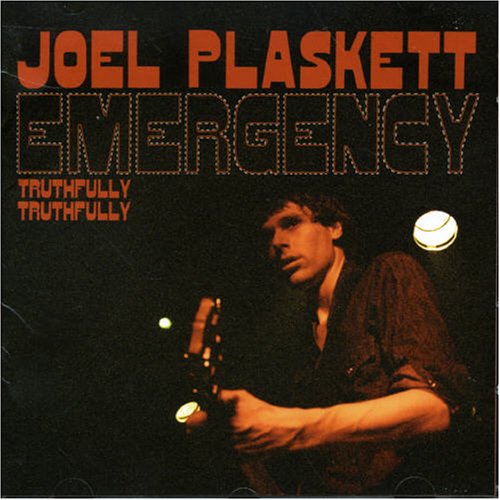
Joel Plaskett Emergency: Truthfully Truthfully

The first song on Joel Plaskett's 2003 album, Truthfully Truthfully, begins with a tangled, twangy sounding guitar, before thickening into a heavy riff that marks the influence of 70's rock that threads throughout Joel's rock songwriting. On Truthfully, there's a confidence to the music that almost kids the listener, matched with the way the lyrics show a very Canadian interest in self-deprecation and suspicion of success. Truthfully, Truthfully almost has two lives, that arena-rock bravado and that shy earnestness. Joel's songwriting keeps the subject matter light and several degrees away from anger or melodrama, but there are gentle putdowns, beginning with that first track, where his admission that "I've got trouble written all over me" sounds less like a boast than a complaint. Another great track is "Mystery & Crime," where Plaskett muses over a relationship gone horrible wrong, where he is the "guilty" party, but still feels put-upon as the situation gets blown out of proportion ("I go to all the parties / And I never have a good time / It's like we're acting out a movie / Mystery & Crime / I never meant to hurt her / Now everybody's screaming murder, murder, murder...") Truth is, on this site, I tend not to fixate too much on lyrics, because I review a lot of music where the lyrics aren't inherent to the enjoyment of the song. But Joel is a for-sure true-blue songwriter. He knows how to turn a phrase, and how to craft a song that will service that.

Looking at songs like "Work Out Fine," "Extraordinary," and "Come on Teacher," are testaments to this. They are loaded with quirky lyrical details to push their stories and characters along. On "Work Out Fine," Plaskett takes a zen approach to the various inconveniences in his life, determined that "Everything will work out fine" just because he says so, while the music is simultaneously at ease and tense. "Extraordinary" is almost parodic, and testifies to Joel's background on the 90's indie rock scene with Thrush Hermit, seeming like something that could have come from a band like Cake or Sloan.

That first half of the album is loaded with character and added value. The second half is very much straightforward, often earnest and in-the-moment rock, exercises in Joel's ability with classic riffage and arena-sized ballads. The piece pivots on ominous "The Red Light" and "Radio Fly," which cracks open Joel's sentimental side with a chorus as big as all outdoors. "You Came Along" is a doe-eyed ballad ballasted by a swaggering rhythm section. "Lights Down Low" is a vintage rocker. Each of the songs have individual flourishes to distinguish them, like the gorgeous guitar break in "The Day" and the way that "All the Pretty Faces" builds to its first chorus and takes off from there. I particularly love the album closer, "Heart to Heart," though, a raggedy minor-key rocker that sounds a bit like Neil Young & Crazy Horse. The way it slips away from the listener ends the album almost as an ellipsis, like there's still more to come... but later.

In the years since this album's release, Joel Plaskett has proven himself one of the most distinctive talents Canada has produced, probably ever. He's earned this distinction, which I just bestowed on him, largely through his more ambitious projects like Ashtray Rock and Three, which show his commitment to developing his craft and setting new projects for himself. But his regular-ass albums are no less appealing, because he's just so goddamn good at what he does. He may play awkward and goofy, but he is most definitely very assured in his artistic talents. When I listen to an album like this, I feel like I "get" the author's voice, that he has really put himself into the work. And while putting yourself into your music doesn't inherently make it better (there are plenty of embarrassingly personal albums that are also awful) when you get someone who knows their work like Plaskett, that self-assurance provides a deep well of material. The songs on this album are so varied, and yet they all have their charms, and all clearly come from the same mind. Terrific.

Buy this album now: iTunes Canada // iTunes USA // Amazon.ca // Amazon.com


Sunday, January 1, 2012

Serious Contenders: Joel Plaskett, "Through & Through & Through"


Good morning. It's 2012 and this is Sound of the Week.

Something I noticed when thinking back on my first year as a music-talking-blog-guy was the power music has to link us to a place and time. Back in November, I went and saw Joel Plaskett in Hamilton (a big deal, since I am a lazyass who doesn't get out much.) In Summer of 2009, just a few blocks across town from the venue, a friend of mine named Cary directed a play I wrote. It was an amazing experience, not just because it happened at all, but because the audiences really loved it.

To introduce the play, which was about waiting for someone to come back, Cary selected this song from Joel Plaskett's album Three. It was the first time I'd ever heard his music and I instantly decided I needed more of it. In those days I was a musical scavenger, mainly feeding off recommendations from my friends and whatever random bands I would hear about through various means.

At the concert, as soon as the opening chords of this song played, the room exploded. It seemed like everyone in the place felt the same things I did, even though that's not possible. I don't think I've ever talked to anyone about Plaskett who didn't cite this as one of their favourites. It's one of those songs where everything just fits together so perfectly that it can't help but reach people.

I got to meet Joel that night. I fanboyed out a bit and told him about the play, and he was very polite as I rambled. We took a very blurry, awful cell phone picture and I shuffled off on my awkward way. In any case, no matter how many times I go on to embarrass myself in front of a professional musician, I'll always have the music, and so will we all.

Keep on rockin'

Thursday, June 23, 2011

#3 - Joel Plaskett Emergency: Ashtray Rock

Yeah, I loved our band, I don't have one regret
I even loved our first two records on cassette.
They were the soundtrack for the night
You and me had that fight
Out in the woods, over some girl we met.

-- "Introduction"

Going back to what I was saying about Pinkerton. If that album's raw, abrasive feel gave it the look of an document of honest, unpolished heartache in progress, here is an album painted generously with a nostalgic sheen, which only highlights rather than obscure the sadness at its core. Its high level of production, beautiful instruments and tight construction draw attention to, rather than distract from, the difficulty of the human heart. I don't have much tolerance for one-dimensional songs of love or heartbreak, and here is an album that manages to hit the double-life of both feelings, the beauty and pain.

I would say that every album on this list could be considered a "concept" album in some sense of the word, bound with underlying themes or motifs. All the albums I've chosen are very deliberate constructions rather than merely collections of songs. This is the only one, though, that is openly conceptual. It tells a story, or at least circles around a loose narrative, outlined in those opening lines: two friends are torn apart when they both meet the same girl at a party in the woods. The reflective tone of the "introduction" informs us we're about to look back to when it all happened. The actual events of the narrative: who did what, hurt whom, remain obscure to me even after 50-odd listens over the past year, but that's not important, because the storytelling here is so strong that I don't have to do too much work to construct the story in my head. All one needs is the suggestions of emotional beats, all of which are hit excellently.

The "Introduction" leads into the wonderful scene-setter, "Drunk Teenagers," which brings us to "Ashtray Rock," a spot in the woods where high schoolers gather to drink whatever booze they could scrounge up. I miss that "getting away with something" feeling of underage drinking, especially since I didn't start drinking until I was 18 anyway. I always get a chill up my spine when I hear that opening zap of fuzzed-over guitars, like a cinematic tracking shot downward over a snowy scene of gathered teens. It's very "In fair Verona where we lay our scene." We get snippets of conversation, including discussions of who can acquire beer, and various drunken ramblings. It's delivered with an anthemic rocking quality that sums up the scene quite nicely: "DRUNK TEENAGERS! Let's start a fight / Out gettin' wasted on a Saturday night!" reveling in the glory of it all. It's beautifully archetypal, tells you exactly what sort of story you're getting. A celebration of the past, for all its dumb parties and heartbreak, a time jsut before you learn you're not invincible.

After another snippet, the Abbey Road-like title track that contains the first indication of how the story goes, "Later on, I see you talking to the beauty / I'm right beside her but you're lookin' right through me." "Fashionable People" then arrives as a character study, a sarcastic appraisal of the kids who have the time and freedom to get loaded in the woods. "The dancers need a dancefloor / The swingers gotta swing, / Fashionable people / Doing questionable things." It and "Penny For Your Thoughts" give us these fragments of narrative but also function well as songs in their own rights with singalong choruses and catchy hooks. Joel Plaskett is one of the single most exceptional songwriters my country has ever produced, because all through this album, and even in individual songs like these, there are so many diverse elements, instruments, verse-chorus structures, that are being put in place, and he pulls the strings perfectly. By the end of these songs, we feel as attached to the characters as they do to each other, even though we aren't watching a movie or reading a book.

The chugging, sinewy, riff-driven "Snowed In/Cruisin'" follows, into the first of three emotional climaxes on the album, the astounding "Face Of The Earth." I would like to break from protocol and define my love for this song by examining what it is not: a wistful, sighing lament, a quiet moan. No, it is as furious and frustrated and pissed-off as anything off Pinkerton. On the page (and in various acoustic versions I've heard,) you could play it low-key, but the Emergency goes balls-out here and makes it a knockout. there's something so defiant about the way the music drops out in the "Rolling thunder" refrain that heightens the tension, the drama, the tragedy. The chorus features guitars the fall like light rain and drums that kick like distant storms. It climaxes with the amazing protest chant "TEARS ROLL DOWN / THE FACE OF THE EARTH! / TEARS ROLL DOWN / THE FACE OF THE EARTH!" where our teenage protagonist demands the planet itself acknowledge his suffering. That shit is straight up Lear. Yes, somehow I've managed to work two completely separate Shakespeare allusions into this review. 'Bout time that degree starts earning its way. It's one of those times in music when you just fucking... feel it.

The next track, "The Glorious Life," is a bit more of a narrative weight-bearer than a song, but it leads into the second climactic moment, the tremendously-worded fuck off, "Nothing More To Say," an anthem of the cold shoulder. "Don't call me up when you figure it out / I got nothin' more to say to you / You had your chance when the truth came out / I got nothin' more to say to you." It's just pure, unadulterated "Fuck this shit!" And while he hammers bitterly against the guitars, the piano underneath the track begs forgiveness, because there's something so sweet and blameless about those ivories.

But for all that slamming of the door, there's another way through, with the bridge-mending "Chinatown/For The Record," which speaks to the power of music to see into the hearts of others, and "The Instrumental," which carries all the power of any other song without the need for words. The amazing thing about music is that pure feeling of feeling without being told in language. It does contain an important spoken-word segment and a few rhyming couplets at the end, but the powerful bit is the lyricless jam.

That brings us where we came in. The third and final peak of the album, the excellent "Soundtrack for the Night," whose opening lines we previously heard as the "Introduction," giving us that emotional resolution, that sense of full-circle. It also contains the best rock and roll usage of castanets ever but that's beside the point. The song absolutely soars, and swoops in for a delicate landing in that last verse that turns the intro on its ear and tells us it wasn't really about the girl as much as it was about the friends.

The album actually has its own "Her Majesty" moment, after a lengthy pause, an "Outroduction" pulls us back out of the narrative, offering a weirdly skewed vantage point and telling a strange anecdote about the time Dave Boyd ran for school president. To me, I guess, it's a weird reminder that no matter how important your problems seem to you, there's a whole world going on around you at the same time.

There's so much to say about this album. It has that perfect blend of personal and universal that all great music must, with the oddly detailed songwriting and very specific song structure blending with timeless themes of heartache and lost friendships, deception and betrayal and in the end, forgiveness. It's ornate and decorated with accessories because that's the way we view the past, but Plaskett never forgets that the good old days never really were that good.

Here is one of the greatest albums of our decade. It doesn't struggle to wrench emotion out of cliches, and it doesn't sentimentalize and it doesn't deny feeling in order to seem cool. Wisely, it finds that sweet spot to signify just enough of its own meaning and let you feel it for yourself. I often have emotional responses to music, but Ashtray Rock is the one, probably the only one, that gets me every time. I swear, every fucking time. That's what's so great about music, like a memory, it allows you to revisit those same feelings over and over, and it's so rewarding, when it's drawn so well as this one, that brings it all out and lets it all go. There will always be a place for this album.

Buy this album from iTunes now!